
Lost Bones #6 (Bears Repeating)
Minnesota's Megafauna Fossil Shortage (Ursus arctos)

In The Beginning
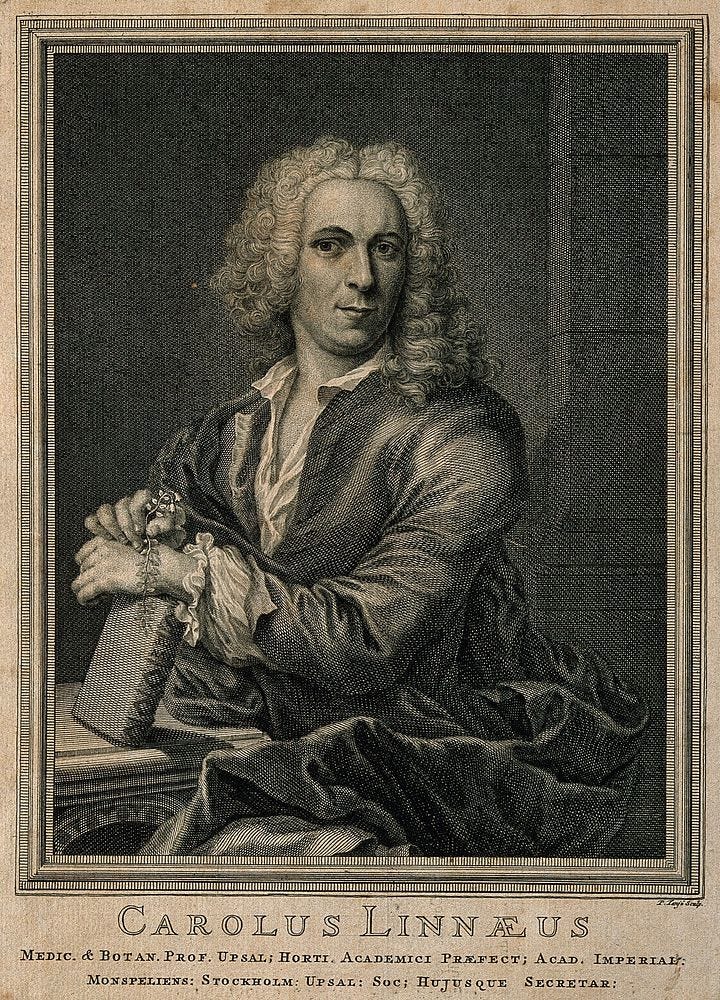
Carl Linnaeus (1707–1778) was a Swedish naturalist, botanist, and physician. He is often referred to as the “father of modern taxonomy” for creating the two‑part (genus, species) scientific naming system used to classify organisms in nature, known formally as binomial nomenclature. Because it is said he worked within the tradition of cabinet zoology—describing species from museum specimens, travelers’ notes, and classical sources—he may not have observed a living brown bear in the flesh. Still, he seems to have been impressed enough by the traits of the formidable beast to place it at the center of bear taxonomy, giving it the very apt name Ursus arctos, from the Latin Ursus (“bear”) and the Greek arctos (“bear”), in the tenth edition of Systema Naturae (Linnaei, 1758). That’s correct: the brown bear’s genus and species is bear bear.
The Ursus arctos record in the Midwest is sparse. Until the coincidental event that prompted this article in the spring of 2024, I was not aware of a single documented specimen from Minnesota—and as I would find out there are some unexpected reasons for this scarcity. In the broader biogeographic history of North American megafauna, brown bears arrived relatively late on the continent—crossing the Bering Land Bridge in the late Pleistocene. As they moved southward, they encountered several biogeographical setbacks, including glacial barriers, shifting habitats, and an unexpected period of overlap with a very formidable competitor—Arctodus simus, the giant short-faced bear. As my initial investigation progressed, I became more and more aware of this competitor’s significance.
In May of 2024, as part of some ongoing research, I had been reviewing small town and county historical museum collections for Pleistocene–Holocene Transition (PHT) mammal specimens for about a year. I did not know it yet, but one unidentified bone in a small collection of random specimens from one county historical society visit would pull me deep into a much larger question: whether brown bears had ever truly been part of Minnesota’s Ice Age landscape. As I began looking into the topic I found two primary types of sources: archaeological sites and scientific papers specifically documenting rare U. arctos occurrences in the Midwestern and Eastern United States. One additional and surprising discovery was a pair of papers indicating that brown bears, U. arctos, gradually had to commingle with Arctodus simus, the giant short‑faced bear in North America. This initially struck me as odd. I had heard of the massive short‑faced bear but at the time my assumption had been that both bears were always present on the continent and that A. simus was just another victim of the megafauna extinctions occurring as the world warmed following the Last Glacial Maximum (LGM).
Bears Across Continents
Researching more, I became aware of how highly separated these two bear lineages actually are—A. simus arising from the Tremarctinae lineage on the North American continent, and Ursus arctos belonging to Ursinae, a Eurasian‑origin “brown bear / black bear” subfamily (Figueirido et al., 2010).
A. simus was one of the largest mammalian carnivores ever to inhabit North America, with adult males estimated at roughly 700–800 kg (1,540–1,760 lb.), although individuals varied greatly in size. Once portrayed as an active super‑predator, its ecology remains debated. The papers I reviewed suggest it was most likely a flexible carnivore and scavenger rather than a specialized high‑speed predator. Stable‑isotope evidence supports a strongly carnivorous diet in northwestern populations (Schubert, 2010; Steffen & Fulton, 2018). By contrast, the Plains grizzly discussed by Mather was a Great Plains form or ecotype of Ursus arctos horribilis, comparable to modern large grizzlies (Stovall & Johnston, 1935), with adult males estimated at roughly 180–360 kg (400–800 lb.). They were flexible omnivores whose diets varied with habitat, season, and food availability. Although plant foods generally formed an important part of their diet, they also consumed fish, birds, small mammals, and carrion. On the Great Plains, grizzlies likely exploited bison carcasses alongside fruits, berries, roots, and tubers (Harington et al., 2014; Mather, 2019).
