
Lost Bones #4 Update — Part 2
Field notes from the quiet middle of the horse project

Progress
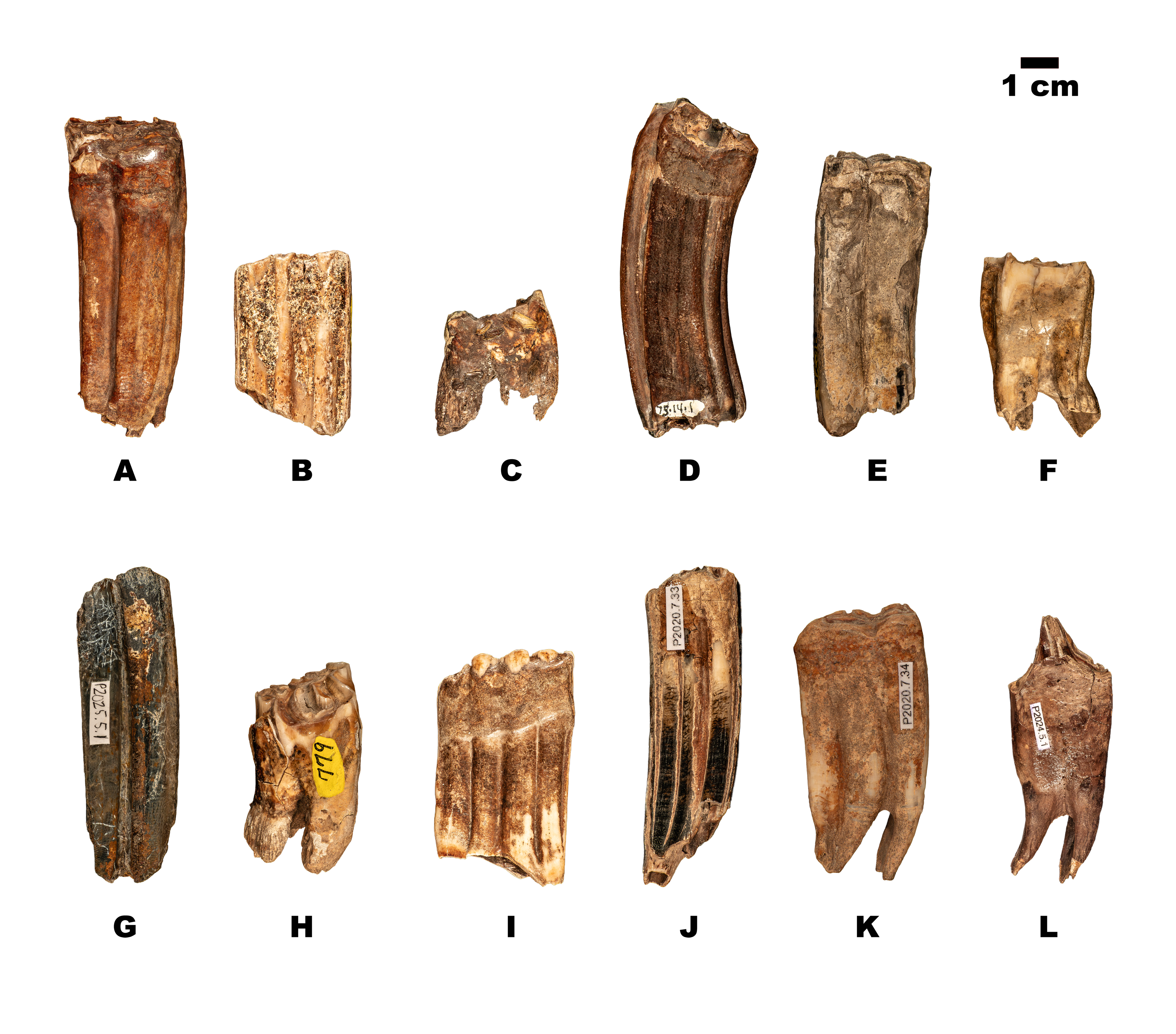
Last month I found myself back on the road with Dr. Alex Hastings from the Science Museum of Minnesota, following the plan we’d mapped out months earlier — visiting the historical societies in Crow Wing, Goodhue, and Wright counties to retrieve the three horse molars needed for the next phase of this project. Each stop was a reminder of how quietly history can sit in county collections. The county specimens are on loan while the rest of the twelve project specimens from around Minnesota are accessioned into the Science Museum’s collection. All of the molars slated for radiocarbon dating are under one roof now.
Still, in my mind I imagine a thread — a filament of time running from the Science Museum back to the county museum drawers and then farther on, to the lake bottoms, gravel pits, and fields where the molars, and possibly the animals they belonged to, lay for decades or even centuries. Along those threads I envision pages hanging: faded field notes detailing stories shared by donors, curators, and individuals still unknown, revealing how the specimens were found and what has kept them safe all this time.
Collagen checks: first signals from the dark
We have some early results thanks to a researcher who recently contacted the Science Museum interested in using near‑infrared (NIR) spectroscopy on Pleistocene–Holocene transition (PHT) mammal specimens. This work builds on a major 2026 paper that refined NIR methods for predicting collagen preservation in archaeological bone.
And guess what—our horse teeth were on the docket.
The scanning process uses a portable NIR spectrometer. A handheld fiber‑optic probe is held against the specimen, in the case of teeth at the root where the most collagen is exposed, delivering a stream of light to the surface; the reflected signal returns back through the probe for analysis. I asked to visit the museum during the process, and it was fascinating to see how quickly a scan could be completed. It took the researcher longer to carefully remove each specimen from the Science Museum’s vault cabinets and position it for scanning than to take the scan itself.
The results will give us an early preview of which teeth have strong collagen content and are most likely to be successfully radiocarbon dated. We may even get preliminary age estimates for some specimens. More to come as I follow up on this work.
The timeline waits like an empty river gravel bar
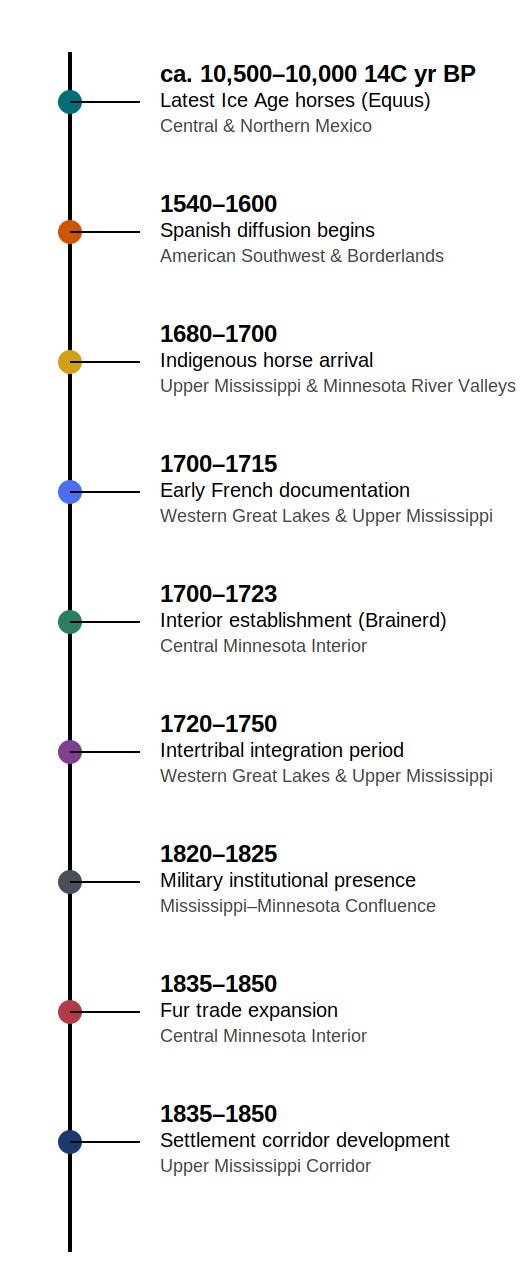
While we work through final details with our grantor, the Minnesota Historical Society (MNHS), I’ve been refining the Upper Mississippi horse timeline. As you may have surmised, the dates we will receive are not only significant if the ages are late Pleistocene/early Holocene but also if there is any indication that these horses are from the era prior to European contact. There are reports that fur traders entering the Midwestern forests in the early 1700s encountered Indigenous peoples who already kept horses. Horses in North America follow a long arc—from Spanish escapees in the 1500s to Dakota–Ojibwe horse cultures in the 1700s, all the way back to the last dated Ice Age horses in North America.
What comes next (the part no one sees)
As mentioned there are ongoing requirements we’re working through with MNHS before the teeth can be shipped out for radiocarbon dating. However all of the teeth have now been CT‑scanned, and photogrammetry has been completed for many of them. You can already view a few of the 3D files on Sketchfab thanks to Kassie Bradshaw Kmitch (introduced in Lost Bones #2).
I previously worked with Kassie and Alex to conduct photogrammetry on a mastodon molar found in Northfield, Minnesota, in 1918, as well as a huge bison skull from Melrose, Minnesota. She does fantastic work! Soon with data from Kassie’s scans we’ll also be recreating each of the horse specimens via 3D printing. Both the CT scanning and 3D printing processes are being carried out so that he have both a full high quality data representation and a physical model of each tooth prior to sampling. Science Museum staff will also be painting the physical reproductions to exactly match the originals.
Hopefully, this update gives you a glimpse into current progress. It is a slow burn at the end of a long haul for me. Whatever the radiocarbon dates reveal will only add more depth to each specimen’s storyline. I have been working on several other projects to distract me from the suspense in the meantime, which I will post more about here soon. I am also gearing up for the summer field season. I have prospective bison sites to investigate in the Twin Cities area and, as always, plan to continue fieldwork in the New Ulm area with my good friend Bill and Alex from the Science Museum of Minnesota.
Thank you so much for following along. More to come soon.
Original Story:
Collaboration:
Crow Wing County Historical Society
Goodhue Count Historical Society
Wright County Historical Society
Sources:
Ryder, M. L., M. J. Collins, and J. A. L. Hedges. 2026. “Refining Near Infrared Spectroscopy for Collagen Quantification: A New Predictive Model for Archaeological Bone.” Journal of Archaeological Science 182 (October): 105678. https://doi.org/10.1016/j.jas.2026.105678.
Beltrami, G. C. 1828. A Pilgrimage in Europe and America. Hunt and Clarke.
Hämäläinen, P. 2008. The Comanche Empire. Yale University Press.
Hubbard, L. F. 1908. “The Territorial Period.” In Minnesota in Three Centuries, 1655–1908, edited by C. E. Gilman, vol. 1. Pioneer Press.
Minnesota Historical Society. American Fur Company Papers. Manuscript Collection, Call No. P558.
Nichols, D. A. 2018. Indigenous Peoples of the Upper Midwest. Wiley Blackwell.
Schoolcraft, H. R. 1834. Narrative of an Expedition through the Upper Mississippi to Itasca Lake. Harper & Brothers.
Sleeper‑Smith, S. 2001. Indian Women and French Men. University of Massachusetts Press.
Weber, D. J. 2005. Bárbaros. Yale University Press.
White, R. 2011. The Middle Ground. 20th anniversary ed. Cambridge University Press.
Witgen, M. J. 2012. An Infinity of Nations. University of Pennsylvania Press. https://doi.org/10.9783/9780812205176